filocriatividade

filosofia para/com crianças e jovens | mediação cultural e filosófica | #ClubeDePerguntas | #LivrosPerguntadores | perguntologia | filosofia, literatura e infância

🟥 quem sou eu?

🟡 [joana rita] Sou licenciada em Filosofia pela FCH da Universidade Católica.
Desde 2008 que viajo pelo país promovendo oficinas de pensamento crítico e criativo, para todas as idades.
Em 2019 concluí o mestrado em Filosofia para Crianças, com a defesa da 1.ª dissertação do país nesta área: Queres saber? Pergunta. (UAc).
Tenho um artigo publicado na Springer, “Why vote? A reflection on the democratic nature of dialogical inquiries” (2023). Em 2025 publiquei dois artigos no Journal of Philosophy in Schools.
Sou a autora do livro Como desenvolver o pensamento crítico das crianças (2025). 

Membro honorário da Federación Mexicana de Filosofía para Niños A.C.
Em 2021 o projecto filocriatividade recebeu o reconhecimento da Cátedra UNESCO/Universidade de Nantes: «Práticas de Filosofia com Crianças»

🟧 subscreva a newsletter

  • 🟦 subscreva a newsletter no substack | 🟣 contacte-me através deste formulário

    joana rita #filocriatividade

    ___

    15940991_1066926656745661_6268340754547635402_n.jp

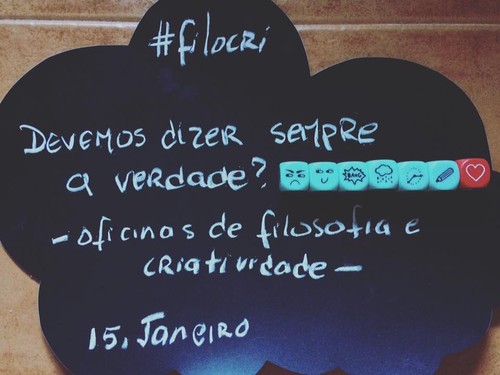
    hoje foi dia de voltar a Benfica, para filosofar. o desafio era pensar sobre a verdade e a mentira. 

    duas oficinas, dois jogos diferentes.

    para a M., presença habitual nestas oficinas, a filosofia é “a joana traz umas cartas para nós fazermos um jogo. temos que fazer perguntas e dar respostas, conversamos todos sobre um tema. a joana escolhe um tema que ela acha que nós vamos conseguir perceber.” 


    e lá demos início ao jogo, entre pessoas que já conheciam as oficinas e as suas regras e pessoas que foram pela primeira vez. 


    a oficina dos mais pequenos começou com um pequeno vídeo, com a história do Pedro e do Lobo. conhecem? pois foi assim que “aquecemos” os músculos do pensamento para o nosso jogo, onde arrumámos ideias em gavetas (imaginárias). 


    divertimo-nos muito com o jogo. para mim foi especialmente interessante ver como, na oficina dos mais novos, as crianças quiseram fazer o papel da facilitadora, fazendo as perguntas na hora de votarmos para arrumar as cartolinas. foi espontâneo e por esse motivo eu também participei na votação, como qualquer um dos participantes. também foi nesta oficina que uma das crianças estranhou o facto das mães estarem muito caladas e não participarem muito. e disse “não é justo, também têm que dar as vossas ideias”. 


    no final, todos os participantes são convidados a falar sobre as oficianas: o que gostaram, o que não gostaram. 

    uma das mães presentes confessou ter ficado surpreendida, pois não conhecia a maneira das crianças pensarem as coisas.

    a mãe T. justificou o seu agrado com a oficina pelo facto de ter sentido que “nós somos adultos e achamos que temos as ideias todas arrumadas e depois quando os ouvimos falar, até ficamos a pensar duas vezes nas coisas que achamos certas.”

    15940332_1066926650078995_5522682446627514996_n.jp


    voltamos a filosofar em Benfica, no dia 12 de Fevereiro.


    para receber a agenda actualizada das oficinas de filosofia, bem como outra informação relevante sobre filosofia para crianças, basta subscrever este blog, ali na coluna do vosso lado direito. 


  • 🟦 subscreva a newsletter no substack | 🟣 contacte-me através deste formulário

    joana rita #filocriatividade

    ___

    “Philosophy is difficult. It encompasses the double demand of strenuous labour under a stern overseer. It requires us to overcome personal biases and pitfalls in reasoning. This necessitates tolerant dialogue, and imagining divergent views while weighing them up. Philosophy helps kids – and adults – to articulate questions and explore answers not easily drawn out by introspection or Twitter. At its best, philosophy puts ideas, not egos, front and centre. And it is the very fragility – the unnaturalness – of philosophy that requires it to be embedded, not just in schools, but in public spaces.

    Philosophy won’t bring back the jobs. It isn’t a cure-all for the world’s current or future woes. But it can build immunity against careless judgments, and unentitled certitude. Philosophy in our classrooms would better equip us all to perceive and to challenge the conventional wisdoms of our age. Perhaps it is not surprising that the president of Ireland, a country that was once a sub-theocracy, understands this.”


    artigo completo AQUI

    autora: Charlotte Blease


    13654342_1136268803110477_6984724880579005359_n.jp


  • 🟦 subscreva a newsletter no substack | 🟣 contacte-me através deste formulário

    joana rita #filocriatividade

    ___

    14624458_1835980846635598_8510419818044719104_n.jp


    Formadora: Joana Rita Sousa 


    Inscrições em: https://goo.gl/D5XcRG


    Registo: CCPFC/ACC-88459/16 (1 crédito – 25 horas)


    Local de realização: Escola Secundária António Damásio (Lisboa) 


    Cronograma:


    28/01/2017   das 08:30 às 13:30h 

    11/02/2017   das 08:30 às 13:30h

    25/02/2017   das 08:30 às 13:30h 

    11/03/2017   das 08:30 às 13:30h

    18/03/2017   das 08:30 às 13:30h


    Objectivos:


    – Refletir sobre o os referenciais teóricos da Filosofia para Crianças e 

    Jovens

    – Identificar ferramentas de aprofundamento filosófico

    – Identificar técnicas de questionamento

    – Contribuir para o desenvolvimento profissional e pessoal dos 

    professores, bem como para  as aprendizagens dos alunos


    Organização: Centro de Formação Escolas António Sérgio 


    Destinatários: Educadores de Infância, Professores dos Ensino Básico e Secundário,Professores de Educação Especial e outros públicos interessados.

  • 🟦 subscreva a newsletter no substack | 🟣 contacte-me através deste formulário

    joana rita #filocriatividade

    ___


    “Today, science is torn between accessibility and authority. Crises of replication and claims of data-dredging appear alongside such phrases as ‘studies say’ and ‘what science tells us’. But the secret, well-known to most scientists, is that ‘science’ doesn’t ‘tell us’ anything. Science is a medium – a really effective one – not a message. Dewey saw it this way: science is less what a set of people called scientists say than it is a way of saying things. Science is a style of reasoning. This is what made children ‘little scientists’, at least originally.

    The story of how science got identified with one particular method remains to be told. The question, then and now, is how far that method extends and who is capable of using it. Casting children as scientists is not about taking science down a peg. Rather, linking the scientific method and child’s play might help us imagine new ways of putting science to work in the world around us.”


    o artigo completo pode ser lido AQUI

    autor: Henry Cowles

    sahbl2upxco-ashton-bingham.jpg


  • 🟦 subscreva a newsletter no substack | 🟣 contacte-me através deste formulário

    joana rita #filocriatividade

    ___

    15 janeiro oficina.jpg

    vamos estar em Benfica, no dia 15 de janeiro! 


    Oficinas de filosofia para crianças e jovens (entre os 4 e os 14 anos) 

    10h – 10h50 – jovens entre os 11 e os 14 anos
    11h – 11h50 – crianças 7/10 *
    12h – 12h50 – crianças 4/6 * 

    * os pais, tios, avós, irmãos mais velhos… também se podem juntar a nós!

    Facilitadora:
    Joana Rita Sousa | filocriatiVIDAde 

    Local:
    GROW UP
    (Benfica)

    Inscrição: *
    8,50 eur / criança
    12,50 eur / criança + acompanhante
    16,00 eur 2 irmãos + acompanhante

    Pf enviar e-mail para info@joanarita.eu com os seguintes dados: 

    – nome da criança e data de nascimento; 
    – contacto telefónico do pai/mãe/avó (…).

    A inscrição é válida após recepção de e-mail de confirmação.

    Todos os participantes deverão levar consigo meias anti derrapantes: vamos sentar-nos no chão, em almofadas. 

    * valor sujeito a IVA, à taxa legal em vigor


  • 🟦 subscreva a newsletter no substack | 🟣 contacte-me através deste formulário

    joana rita #filocriatividade

    ___

    Laurance Splitter is a reference to me and to all of you who study P4C (philosophy for children). Laurance has been working in this area since 1983/1984 and I’m really used to quote him on my academic work. 

    I feel like a real rookie, next to professor Laurance. Laura D’Olimpio encouraged me to write to him, so that my blog could share with you another point of view from someone who practices #p4c, for such a long time. 

    Thank you, professor Laurance!


    *


    Can you recall the first time you heard about philosophy for children (p4c)? “I think it was early in 1982. I met Matthew Lipman later that year when I was taking Sabbatical leave in the USA.”


    And how did you start working with p4c? “In early 1983, I contacted the state government at the time, and showed them some of the original p4c materials written by Lipman and Sharp. Their unenthusiastic response taught me that this is the wrong place to start! So I began contacting schools and teachers and arranged to sit down with primary school children in 1984 so I could claim at least some experience of doing philosophy with children, not just talking about it. With several other volunteers, we formed the first national p4c association, based in Sydney, Australia, in 1985, at the first “teacher educator” workshop which I organized. Matthew Lipman and Ann Sharp directed this workshop, and participants included philosophers, principals and teachers from around Australia. These people were instrumental in setting up local associations and networks in their own regions over the next few years, leading to the establishment of a national federation in 1990. One thing I realized early on is that despite my own passion and commitment – indeed, because of them – it was important to set up state and regional organizations which were reasonably democratic and would outlast the particular individuals who served on them. P4c should never be any one person’s “pet” project.”


    In your opinion, what is the most important skill that a P4C teacher must have? “Along with such attitudes as a love of philosophy, a good degree of intellectual humility, and a commitment to teaching young people to think well, I think there are several key skills which are equally important, including: listening carefully, asking appropriate questions at the appropriate time, and developing an “ear” for what constitutes a philosophical direction or focus. Although it is not the teacher’s primary task to provide answers to philosophical questions (even if she thinks she knows them!), this philosophical “ear” usually requires a degree of familiarity with philosophy, so that one has a sense of the great dialogical tradition that children are invited to join. In practice, this is not always possible for classroom teachers, so it helps to have experienced philosophers on hand as well. Conversely, professional philosophers may not be particularly good teachers so, ideally, it is great when teachers and philosophers can work together.”


    Do you think p4c is necessary to children? Why? “Interpreting “p4c” broadly to mean “doing philosophy with children and adolescents”, I certainly think it is important. Since many children survive in the world without much – if any – contact with philosophy (especially if their own philosophical musings are ignored), it is too strong to say that p4c is strictly necessary. It is even possible for young people to grow into thoughtful, reasonable and respectful adults without the benefits of philosophy, but this is much more likely if they have had the benefit of being members of a community of philosophical inquiry. I say this because, in my view, such a community empowers children to think conceptually and, thereby, to appreciate the ethical, logical, metaphysical, epistemological and aesthetic dimensions of their experiences.”


    What makes a question a philosophical question – from a p4c point of view? “We seem always to come back to this “meta” question, partly because it is important, and partly because we keep rethinking the answer! As tempting as it is to refer to such features as openness, having no (universally accepted) answers, etc., I no long favour this approach, just because they are features of any kind of genuine inquiry, whether philosophical or not (scientific or historical, for example). More precisely – since others will point out that scientific questions do or will have accepted or settled answers, at least in the scientific community – I think that a good teacher of inquiry-based learning and thinking knows how to create the sense of openness – even tension – among students that comes from feeling unsettled or puzzled by the questions they explore. Coming back to the question, I tend to fall back on the idea that philosophical questions are those that deal essentially with concepts and their meanings.”


    What’s the biggest challenge p4c faces, nowadays? “I am not sure if there is one universal challenge, as a lot depends on time and circumstance. Still, I am tempted to point to the relatively recent and alarming rise in “populist” thinking that is evidenced by recent political events. Populist thinking tends to downplay such norms as reasonableness, truth and judgment in favour of looking to those who promise quick and easy solutions to problems. As the term suggests, it makes the terrible mistake of assuming that the most popular answer is the best answer, no matter if it is shown to be false or contradictory. In such an environment, many people will simply have no time or patience for the kinds of careful and deep deliberation that philosophy requires, or for the crucial idea that there is nothing noble about absolute certainty. Of course children will still be curious and ask lots of questions, but the adults who govern their lives have the power to deny them the opportunity to do philosophy, by discouraging their questions, demanding unquestioned obedience, and pushing a “dumbed-down” curriculum in schools and classrooms. There is a positive dimension to this issue. IF more children engage in philosophical dialogue and inquiry, the chances are good that they will develop both the skills required to think well, and the dispositions that accompany them, including a concern for the truth (and for telling the truth). Such children are unlikely to become “populists”!”


    Can you give the teachers and the parents some kind of advice to help them deal with the children’s questions?

    “Some questions require, or deserve, straight-forward responses (“Is Grandma coming today?”, “Is it ok to cross the road now?”, for example). But both in philosophy class and in ordinary life, those with a philosophical “ear” (as noted above) can often discern that children’s questions provide great opportunities for thoughtful discussion. In these cases, it is neither necessary nor desirable to simply “answer” their questions. As other writers have pointed out, children’s questions are often “invitations” to “play with” ideas and thoughts. Since most such questions already reflect a good deal of thinking on the child’s part, one good strategy is ask them, in turn, “What makes you ask that?” or “What are you thinking about here?”

    More generally, we need to take their questions seriously, and check with them before assuming we know exactly what they mean. As for sharing our own views on substantive issues with children, I think it depends on the extent to which they have mastered or internalized the tools of deliberative inquiry. For example, if they are satisfied with what we say simply because we are the “clever” adults in charge (as teachers or parents), then they are not yet thinking for themselves.”


    This is one of my favourite questions, because I think we all have curious stories related to the children’s questions. Laurance, did the children ever surprised you with a question? Can you share that question with us? “This is an empirical question that relies on my having a decent memory – something about which I am no longer so sure! But I will always remember one particular question that came up during a fourth grade class demonstration which was actually being videoed for television. It was one of my very first experiences doing philosophy with 9 year olds and I was quite nervous, particularly because the cameras were rolling throughout the lesson. We read a chapter from Matthew Lipman’s novel Pixie which raises all kinds of metaphysical issues to do with relationships, mind, space and time, etc. At the end of the reading I asked the kids if there was something they found especially interesting or puzzling – and was met with complete silence!

    I have learned since then that silence can, indeed, be “golden” but back then every second seemed like an hour, and still the students seemed to have nothing to say. Finally, much to my relief, one child put his hand up. His question: “What’s that funny mark at the bottom of the page?” (pointing to a smudge made by the photocopy machine). What to do with such a blatantly non-philosophical question? Simply answer it? Ask if anyone else can answer it? Ask the questioner what made him ask that question? Fortunately, I opted to take his question seriously and wrote it up on the board with his name next to it. I explained that all questions are welcome and that this was his question which he was kindly giving to the class community. At that point several others raised their hands to ask questions which lead to some great dialogue; but they had been encouraged by that student’s willingness to break the silence and ask the first question.


    196053_10150421708430022_5337684_n.jpg


    📷 Laurance Splitter, on facebook

    ⚠️ bolds are my responsability


  • 🟦 subscreva a newsletter no substack | 🟣 contacte-me através deste formulário

    joana rita #filocriatividade

    ___

    filosofia é coisa para miúdos.jpg


    sintonizem em http://www.radiomiudos.pt  – também podem descarregar a app e ouvir onde quer que estejam


    15747558_359013881120778_1596355849715776935_n.jpg


  • 🟦 subscreva a newsletter no substack | 🟣 contacte-me através deste formulário

    joana rita #filocriatividade

    ___

    15539067_669457206567329_8746331359317852160_n.jpg

    na última semana de aulas não tivemos propriamente aulas. é verdade: final do 1º período, cansaço acumulado (da minha parte e dos pimpolhos) e toda uma energia canalizada para as férias e para as coisas mais natalícias.

    houve dias em que o são pedro colaborou com bom tempo e acabámos por ir para o recreio brincar. levei alguns jogos (de mímica, eles adoraram) e combinámos que cada um poderia fazer aquilo que quisesse. houve quem jogasse à bola, quem apanhasse folhas caídas no chão, quem quisesse desenhar no caderno da filosofia… cada um podia escolher o que queria fazer. 

    nos dias em que o são pedro não colaborou – afinal, estamos em dezembro… é natural que haja frio e chuva! – ficámos na sala e as regras do tempo livre continuaram: podem fazer o que quiser, agradecendo que não corram nem joguem  à bola. inventámos jogos, desenhámos, fizemos colagens. dentro daquele espaço que é a sala de aula, imperou a liberdade e a autonomia. e eu brinquei com eles.


    a dada altura, o R. vem ter comigo e diz-me: “obrigada, joana, por nos teres dado este tempo livre todo”. perguntei o porquê. a resposta: “andamos a aprender muitas coisas ao mesmo tempo, quase não temos tempo para descansar.” 

    numa outra sala, um outro aluno confessou que “aprendemos tantas coisas com a professora [titular] que ficamos baralhados. e não temos tempo para pôr tudo em ordem.” 


    falamos de alunos do 1º ano, do 1º ciclo, que já vão sentindo a pressão do tempo que não chega para tudo, dos TPC e de tudo aquilo que envolve o ambiente escolar. 


    a minha tarefa é ingrata: estou com eles entre as 16h30 e as 17h30 e por isso, dentro do que é a filosofia para crianças, opto por metodologias o mais lúdicas possível. afinal, já dizia o Heraclito qualquer coisa como: o tempo é uma criança que brinca e joga. brincadeira de criança.” 


    15337072_1211490335597441_6045299565861535744_n.jp


    que nunca nos falte o tempo para brincar.

    que nunca nos falte o tempo livre.


  • 🟦 subscreva a newsletter no substack | 🟣 contacte-me através deste formulário

    joana rita #filocriatividade

    ___

    are on mych-2.png


  • 🟦 subscreva a newsletter no substack | 🟣 contacte-me através deste formulário

    joana rita #filocriatividade

    ___

    15590229_356354061386760_3016994501972877950_n.jpg


    É um espaço para perguntas e respostas, para cultivar o espanto e o porquê. Aqui a  filosofia é trocada por e para miúdos! Um programa de Joana Rita Sousa.

    Terças e Sábados, às 4h00, às 12h30 e às 18h30.


    Onde? Aqui mesmo, na Rádio Miúdos!

  • 🟦 subscreva a newsletter no substack | 🟣 contacte-me através deste formulário

    joana rita #filocriatividade

    ___

    15306731_936649469802193_5953422179516284928_n.jpg

    podemos, sim! claro que podemos.  

    basta uma pergunta para “treinar” os exemplos e as justificações. 

    “o que é um bom presente?” – foi este o pontapé de saída para uma reflexão sobre o natal. descobrimos que nem todos os presentes são coisas, que há razões diferentes para dizer que isto ou aquilo é um bom presente. e que por vezes presentes diferentes são bons, pela mesma razão.


    e para vocês, que estão aí desse lado – o que é um bom presente? podem dar um exemplo e explicar por que é que o consideram um bom presente?

    aproveitem para parar para pensar, a sós ou na companhia dos vossos filhos ou alunos.


    aguardo as vossas respostas!


  • 🟦 subscreva a newsletter no substack | 🟣 contacte-me através deste formulário

    joana rita #filocriatividade

    ___

    Transformar-a-sala-de-aula-numa-sala-de-pensar-Có


    filosofia para crianças e jovens – formação em formato e-learning – 25h

    formadora: Joana Rita Sousa

    inscrições + informações AQUI 


  • 🟦 subscreva a newsletter no substack | 🟣 contacte-me através deste formulário

    joana rita #filocriatividade

    ___

    I met Peter Worley on facebook. I think I was searching for new resources on #P4C and I found about one of his books: The If Machine. Peter was (well, is!) very nice to everyone who approachs him on social media and we started talking about P4C, resources, about how things are going on in the UK and Portugal. Peter is the president of SOPHIA and I joined as a member. Peter asked if I could help him finding out about a place to held the next SOPHIA member’s meeting. We talked about it and – guess what? – the meeting will be held in Aveiro, Colégio D. José I, on July 2017. Right after ICPIC, in Madrid. 

    And now, ladies and gentlemen, I give you The If Man aka Peter Worley.


    *


    Peter, can you recall the first time you heard about philosophy for children (p4c)? “Because I had begun doing philosophy with children off my own back and with nothing other than my years of music teaching/counselling experience to help, my colleagues at the SPP (Society for Philosophy in Practice) put me in touch with their P4C practitioner. Through her, I found out about SAPERE and attended a Level 1 training course.”

    How did you start working with p4c? “Before I had heard about p4c and Sapere, I was a guitar teacher in schools with an academic background in philosophy and an interest in philosophy outside of academe. After my first degree I trained with Tim LeBon to become a philosophical counsellor while completing an MA in philosophy. So, three things came together: music teaching, philosophy and counselling, and they led me naturally to think about doing philosophy with the children I worked with. At that time, I was unaware of a tradition of doing philosophy with children. The question is: is what I did then and do now P4C? I do philosophy with children (the phrase ‘philosophy with children’ is meant purely descriptively – it is not an acronym or a brand: I do X with F). Also, what I do when I do philosophy with children is not so different (though there are some differences) from what I do when I do philosophy with adults. So, I might prefer ‘P4X’. ‘X’ could be ‘children’, ‘teachers’, ‘adults’, ‘philosophers’ etc. Also, is it ‘P4C’ (for) or ‘PwC’ (with)? Is it ‘over’, ‘under’, ‘between’, ‘around’, ‘through’? Never really quite figured that one out (but looking at these, I quite like ‘between’ or ‘through’). I will be chairing a panel discussion at the next ICPIC conference in Madrid (2017) entitled ‘What does ‘P4C’ capture?’ with the aim of attempting to answer this question. Questions we might explore are: ‘Is p4c a referring term or a catch-all term?’, ‘Are there rules about who can use it?’, ‘Does it refer only to those within the Lipman tradition?’ and ‘If so, how close does one need to be to that tradition to be considered within it?’ When I write about what I do, I’ve taken to simply saying ‘philosophy with children’, ‘philosophy in schools’ and ‘philosophy in classrooms’. The particular approach that we at The Philosophy Foundation have developed we call ‘PhiE’, which simply stands for ‘philosophical enquiry’. But even then, if you run a PHiE, no philosophy is guaranteed. It is the hope. And with greater expertise from the facilitator, and with practice by the group and facilitator, the hope becomes more likely; and if not today then tomorrow. To find out more about PhiE go here: www.philosophy-foundation.org and here: https://kcl.academia.edu/PeteWorley


    Thanks, Peter. We shall check out your links. But tell me, do you think p4c is necessary for children? “Why? It depends what you mean by ‘necessary’. (A typical philosopher’s answer, I know!) If we mean a sine qua non then no, it’s not, children can get by in their education perfectly well without it. If, on the other hand we mean ‘necessary to achieve y’ then, maybe it is. And this depends on what we perceive the goals of education to be: functional or ideal?


    If education aims to produce functional citizens then there are many things that might be considered unnecessary: maths (beyond arithmetic), music, drama and maybe science among them (putting to one side specialisms). But if education aims to produce an ideal learner, a cognitive and moral agent, then you might say, as I do, that philosophy is necessary towards that end. Philosophical thinking is particularly well-placed to develop intellectual agency. How philosophy is to be implemented in education, whether p4c for instance is the right or only way to go, is another question.”


    Nowadays children, at least at portuguese schools, have a lot of activities. Why should we take philosophy to schools? “Having said what I’ve just said, I do think that some strong cases can be made for doing philosophy in schools, without having to commit to its being necessary. A case can be made on the basis that it helps to develop reasoning, or more broadly, intellectual virtues, that it equips children to deal with incoherence, ambiguity, inconclusiveness, uncertainty. And whatever you think about philosophy being necessary for education, I think philosophy is inescapable if you’re human. Providing children with the language and methods to deal with something that they will, at some point, encounter could make a good case for an intervention such as philosophy. Prof. Michael Hand thinks that something like this is the case regarding political and moral aspects of civic life (that education informs). Philosophy is also a good antidote to the ‘pressure cooker’ environment the children find themselves in most of their school life. Having a ‘space to think’ may, for some, be considered a necessary part of any child’s school life, sufficient reason for its inclusion in education; but, I would caution: only if it remains a ‘space’ and doesn’t itself get sucked into the pressure cooker climate of testing and over-evaluation. As I mentioned briefly earlier, I also think that philosophy develops certain intellectual virtues and though philosophy is not unique in this, there is a case to be made for it being best placed to do this.


    The kinds of virtues I have in mind are: re-evaluation, judiciousness, developing a synoptic view, all of which develop metacognitive skills. In other words, philosophy is well-placed to develop a reflexive relationship between our ‘inner Socrates’ and our ‘inner slave boy’ (see Plato’s Meno). In effect, philosophy’s special ‘outside-of-itself-and-everything-else’ character helps to develop one’s own inner moral and cognitive ‘guide’. Could this be what Socrates meant by ‘his daimon’ in Plato’s Apology? However, I should point out that it is not a foregone conclusion what it is the guide should lead one to. In other words, I dispute the popular view that doing philosophy necessarily makes you a morally better person or that philosophy leads children to broadly liberal, communitarian values; philosophy is also subversive, iconoclastic and disruptive. I’m currently writing a piece on this for The Journal of Philosophy in Schools special issue on why we should teach philosophy in schools. So, keep an eye out for that!”


    I remember reading an article that you wrote about questions. Can you tell us what makes a question a philosophical question – from a p4c point of view? “Probably its openness. There is the openness of the question itself – it should be contestable, leading to controversies; and there is the openness of the philosopher – he or she should adopt what I call a position of defeasibility. (See here for more this: http://www.innovatemyschool.com/ideas/item/52-socratic-irony-in-the-classroom-clouseau-or-columbo?.html and http://www.ojs.unisa.edu.au/index.php/jps/article/view/1350 ) It should also get beyond first-order, surface considerations. For instance, ‘Who started the war?’ is not a philosophical question, but there are philosophical questions lurking very close by: e.g. ‘What is a war?’, ‘Under what circumstances would war be justified?’, ‘How can we decide what constitutes the cause of a war?’ Even these are only philosophical if they are treated in a philosophical way. For instance, ‘What is a war?’ might be answered by looking in a dictionary and, if the group feel that the matter is settled, then the question would not have been treated philosophically; but the fact that it still could be means that it has philosophical potential, even if it’s not been tapped yet by a particular group. But with regard to P4C (or philosophy with children), practically rather than theoretically speaking, I would say a good question is one that results in a philosophical conversation with the least amount of effort from the facilitator. Often the question needs to be linked to some kind of situation or other stimulus for contextualisation. For example, in the context of the situation of ‘the ship of Theseus’ (a ship that has all its parts replaced gradually over time) the question, ‘Is it the same ship?’ is perfect. I also think that (and this is not without exception, just a general observation) a good question is grammatically closed (where the answer is a one-word or short phrase answer) but conceptually open (it is contestable): e.g. ‘Is the mind the same as the brain?’ These kinds of question have the best of both worlds: the focus of a closed question but the elaboration of an open question.”


    What’s the biggest challenge p4c faces, nowadays?


    “There are several challenges: training, funding and resources, but in my view, the biggest challenge is maintaining quality. Making sure that philosophy is done when p4c is done, making sure that it doesn’t get over-simplified and done in the wrong way. Just to take a couple of examples: philosophy should not be used to explicitly lead children to desirable conclusions (particularly moral, political or religious ones), children should not be misled into thinking that ‘there are no right and wrong answers in philosophy’, and it should also not be hijacked for political ends, such as for sniffing out terrorists (the UK has a ‘Prevent’ agenda that p4c is being drawn into) or for promoting (for e.g.) ‘British values’ (another agenda p4c is being used for); to problematise them, yes, but not to blatantly promote them.”


    Can you give the teachers and the parents some kind of advice to help them deal with the children’s questions? “Don’t focus too much on questions! I was in a Year 1 (ages 5 and 6 years) class the other day and we (the teacher and I) tried to run a standard p4c session with the book ‘Frog is Frightened’ by Max Veltjuis and when I asked them to come up with questions about the story the children didn’t know what a question was. (I did an exercise with them where I taught them what a question is and what a statement is and we sorted what they said into questions and statements and this worked very well). What we noticed was that the children became the most animated when one girl said, ‘Ghosts don’t exist’. Now, that’s not a question! So, we could either continue with the process of question-formulation, gathering and voting, or we could just ‘go with the children’. And that’s what we did. The point here is: 1) don’t worry too much about the procedure (be ready to jettison any procedure at any time) and 2) don’t worry too much about questions; statements can be just as – if not more – effective at provoking discussion. And actually, very young children are more likely to respond with statements than questions. This is not a problem though; just go with it. I call it the ‘Quote. Discuss.’ strategy; a common ‘question’ approach for degree and higher exams that works just as well with younger students. I also like tasks such as ‘Do nothing’ or ‘Think of nothing’ or ‘Draw a round square’, or ‘Do a deliberate mistake’. So, it’s not always about questions. The next SOPHIA meeting, here in Portugal, will be entitled ‘Questioning questioning’ and we will be looking in some depth at this and many other related aspects of questions and questioning in the facilitation of philosophical conversations. So, do come along!”


    Did the children ever surprise you with a question? Can you share that question with us? “Yes: ‘Do you paint your hair grey!’ and ‘Have you had medical difficulties this week, Mr. Worley?’ But if you mean philosophical questions, then, ‘yes’ to that too. One that sticks in my mind is when we had pretty much finished the session and I had been ‘boarding’ a good deal during the session (I don’t always do this) and one very philosophical boy put his hand up and said (while pointing to the board), ‘Mr. Worley, we’ve heard all these ideas today but how are going to decide which one’s right?’ I think this is one of the most profound questions I’ve heard (interestingly, not a voted-on enquiry question; just one that came up spontaneously – my favourite kind, by the way). His question reminds us that philosophy is not just a sharing forum, it has an evaluative aspect that is sometimes forgotten. Philosophy doesn’t just explore, it has to move to an eliminative, evaluative stage too. Good questions we (philosophy facilitators of whatever school) should all ask ourselves are: how often do my philosophy sessions move beyond simply sharing and exploring? And how do I/we move to meta-analyses in the classroom? And how do I/we move to the elimination and evaluation of ideas? Though there are ways to do this, it is not easy and I’m never satisfied that I or the p4c community has properly answered his question. I’d love to hear from anyone who thinks they have!”


    Thank you Peter!

    See you in Madrid and then Aveiro! 


    1545837_10152182000457359_1379096590_n.jpg


  • 🟦 subscreva a newsletter no substack | 🟣 contacte-me através deste formulário

    joana rita #filocriatividade

    ___


    2017 marca o regresso dos encontros SOPHIA ao nosso país.

    nos dias 3 e 4 de Julho o Colégio D. José I, em Aveiro, acolhe a iniciativa que está aberta a todos os membros desta rede europeia 


    mais informações AQUI 


    Screenshot 2016-12-04 14.11.54.png


  • 🟦 subscreva a newsletter no substack | 🟣 contacte-me através deste formulário

    joana rita #filocriatividade

    ___

    Perguntas2017 Flyer.jpg

     informações através do centro de formação

    link para inscrição: https://goo.gl/D5XcRG